Who has to file
Every business registered for VAT with the Federal Tax Authority (FTA) must file a return for every tax period, even a period with no sales or purchases. A nil return is still a return, and it still has a deadline. If you are not registered yet, start with the VAT registration threshold guide.
The standard VAT rate in the UAE is 5%. Some supplies are zero-rated (for example most exports and international transport) and some are exempt (for example certain financial services and residential rent). The return separates all three, which is why your invoices and expenses need the right VAT treatment from the day they are recorded, not at filing time.
Tax periods and the 28-day deadline
The FTA assigns each registrant a tax period. Most small businesses file quarterly; businesses with annual turnover above AED 150 million file monthly. Your assigned periods are shown on your VAT registration certificate and in EmaraTax.
The return and any payment are due within 28 days of the end of the tax period. For a quarter ending 30 June, that means 28 July. When the 28th falls on a weekend or public holiday the deadline moves to the next working day. Payment must actually clear with the FTA by the deadline, so allow a day or two for bank transfers.
The VAT 201 form, box by box
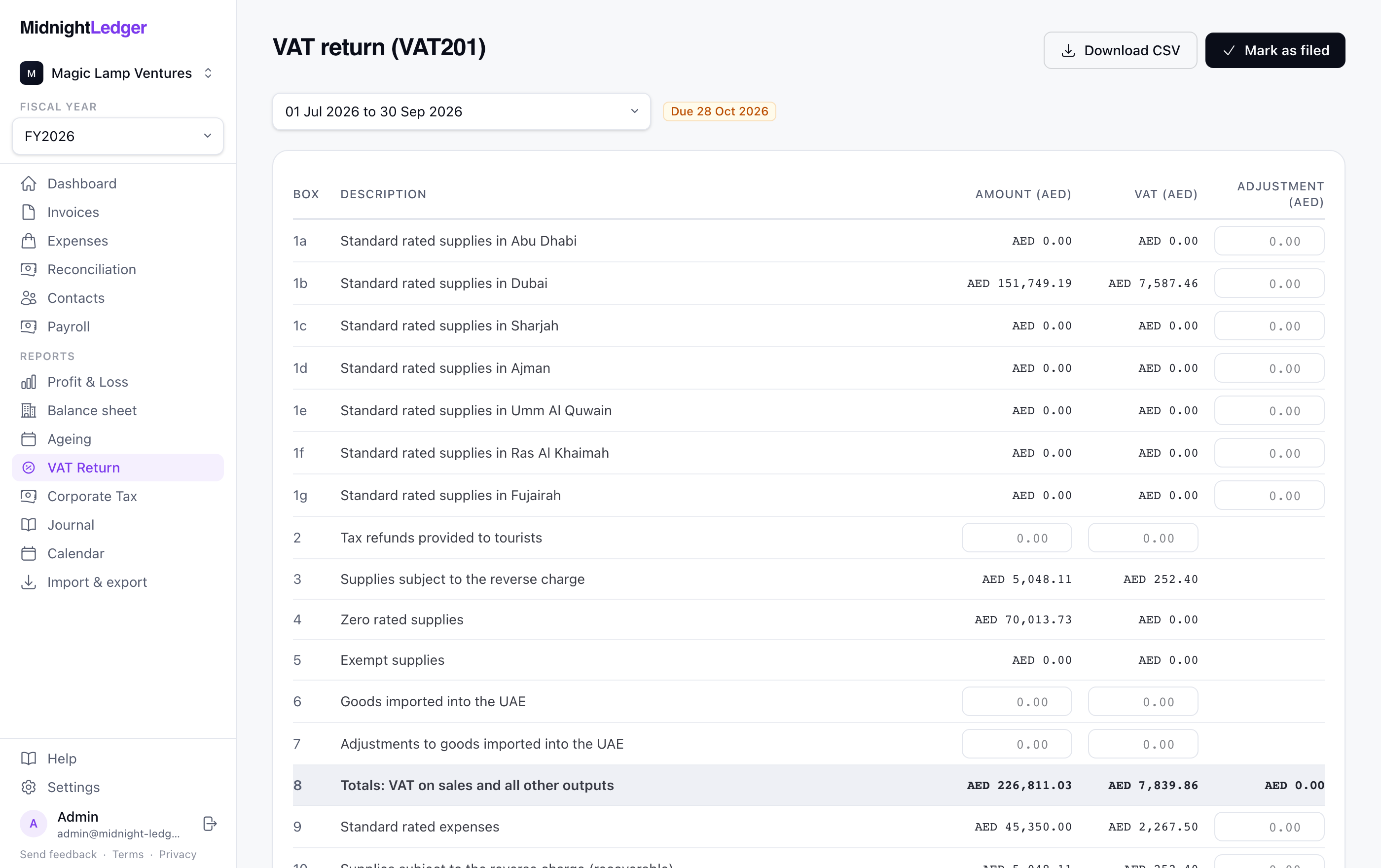
The VAT 201 has two halves: VAT on sales and other outputs, and VAT on expenses and other inputs. Each box has an amount column (net of VAT) and a VAT column, plus an adjustment column on some boxes.
Sales and outputs
- Box 1 (1a to 1g): standard-rated supplies, split by emirate. Your 5% sales go in the box for the emirate where the supply took place, normally the emirate of your fixed establishment. A Dubai business usually reports everything in 1b.
- Box 2: tax refunds provided to tourists. Only relevant if you are in the tourist refund scheme.
- Box 3: supplies subject to the reverse charge. Services and goods you bought from outside the UAE where you, the buyer, account for the VAT.
- Box 4: zero-rated supplies. Exports and other 0% sales. The VAT column is nil but the amount must be reported.
- Box 5: exempt supplies. Amount only.
- Box 6 and 7: goods imported into the UAE and adjustments to those imports. Box 6 is usually pre-filled from customs declarations linked to your TRN.
- Box 8: totals. Calculated for you.
Expenses and inputs
- Box 9: standard-rated expenses. Purchases where you paid 5% VAT and are entitled to recover it. You need a valid tax invoice from the supplier for every amount in this box.
- Box 10: supplies subject to the reverse charge. The input side of Box 3, so the same amounts appear here if the purchase is recoverable.
- Box 11: totals.
Net VAT
Box 12 is total output VAT, Box 13 is total recoverable input VAT, and Box 14 is the difference: what you pay the FTA, or what you can carry forward or claim back.
Keeping books that fill the return for you
Most filing stress comes from doing the classification at the end. If every invoice carries the right rate, emirate and place of supply when it is issued, and every expense records its VAT and the supplier tax invoice when it is posted, the return is a report you read rather than a spreadsheet you build. A few habits make the difference:
- Issue proper tax invoices for every sale: the words "Tax Invoice", your TRN, a sequential number, the date, the customer details, and VAT shown per line and in total. Simplified tax invoices are allowed for supplies under AED 10,000 to unregistered customers.
- Only recover input VAT on expenses where you hold a valid tax invoice in your business name. A card receipt with no TRN does not qualify.
- Record foreign supplier invoices as reverse charge at the time of purchase so Boxes 3 and 10 are right.
- Reconcile your bank every month. Unrecorded income is the most common reason a return understates output VAT.
- Lock the period once filed. If a late invoice turns up, correct it in the next return (or a voluntary disclosure if the error is over AED 10,000) rather than editing history.
Penalties
The FTA penalises late returns and late payments separately. A late return costs AED 1,000 the first time and AED 2,000 for a repeat within 24 months. Late payment attracts a percentage penalty that starts the day after the deadline and grows monthly, so a late return with tax owing is expensive fast. Registering late for VAT in the first place is a separate AED 10,000 penalty.
Records you must keep
Tax records, including invoices, credit notes, import documents and your ledgers, must be kept for at least five years after the end of the tax period they relate to (15 years for records relating to real estate). Keep them in a form you can produce for an FTA audit. The FTA Audit File (FAF) is the official export format; Midnight Ledger generates it in one click.
Frequently asked questions
Do I file a VAT return if I had no transactions?
Yes. Every registered business files for every tax period, and a nil return that is filed late is still penalised.
How do I know if I file quarterly or monthly?
Your tax period is assigned by the FTA when you register and shown on your certificate and in EmaraTax. Businesses under AED 150 million in annual turnover are normally quarterly.
Can I recover VAT on all my expenses?
Only on expenses used for making taxable supplies, and only where you hold a valid tax invoice. VAT on entertainment for non-employees, and on cars available for personal use, is blocked.
What if I made a mistake on a filed return?
Errors of AED 10,000 or less in tax can be corrected in the next return. Larger errors need a voluntary disclosure through EmaraTax, which carries its own penalty scale.
Sources
This guide is general information for UAE small businesses, not tax or legal advice. Rates, thresholds and deadlines are checked against Federal Tax Authority and Ministry of Finance publications on the date above, but the rules change. Confirm anything that matters with the FTA or a registered tax agent.