The rates
| Taxable income | Rate |
|---|---|
| Up to AED 375,000 | 0% |
| Above AED 375,000 | 9% on the portion above the band |
The 0% band is not an exemption from registering or filing. It is a rate applied to the first AED 375,000 of taxable income, which is your accounting profit adjusted for a short list of disallowed or exempt items. A business with AED 500,000 of taxable income pays 9% on AED 125,000, so AED 11,250.
Who has to register
All companies incorporated in the UAE, including free zone companies, must register with the FTA for corporate tax and obtain a tax registration number. This is separate from VAT registration. Individuals (sole establishments, freelancers) must register once their business turnover exceeds AED 1 million in a calendar year.
New companies must register within three months of incorporation. Missing the registration deadline carries an AED 10,000 penalty, although the FTA has waived it for businesses that file their first return within seven months of the end of their first tax period.
Small Business Relief
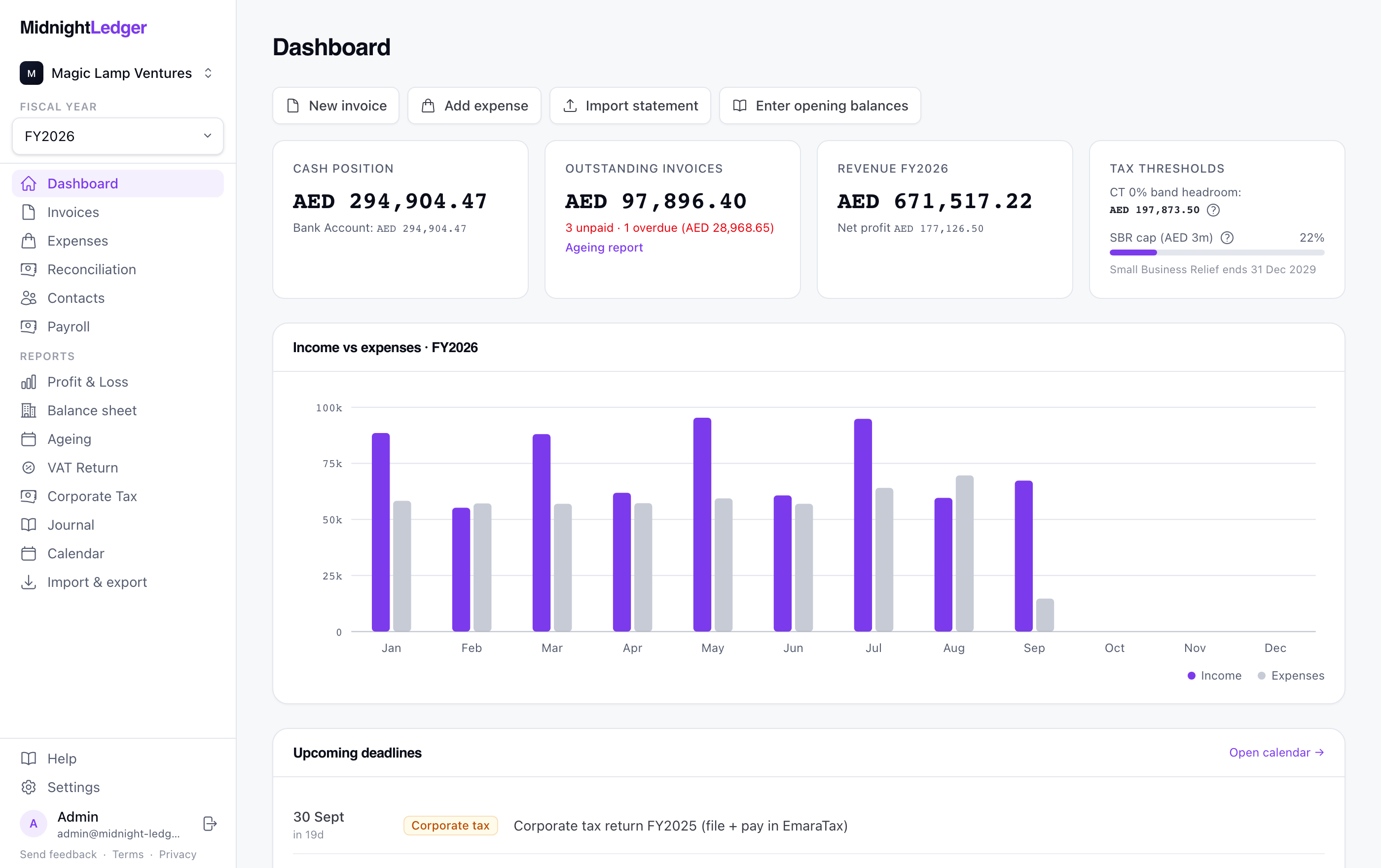
Small Business Relief (SBR) lets a resident business with revenue of AED 3 million or less in the current and all previous tax periods elect to be treated as having no taxable income, which means no corporate tax to pay for that period. The relief was originally due to lapse at the end of 2026; in August 2026 the Ministry of Finance extended it to tax periods ending on or before 31 December 2029.
Three things to know before relying on it:
- The test is revenue (turnover), not profit. A business with AED 2.9 million of revenue and AED 1 million of profit qualifies; a business with AED 3.1 million of revenue and a loss does not.
- It is an election made on the tax return. You still register, keep books and file every year.
- It is not available to Qualifying Free Zone Persons or to members of multinational groups with consolidated revenue above AED 3.15 billion.
Electing SBR also means you cannot carry forward that year's tax losses or claim certain deductions, so a loss-making year is sometimes better filed at the normal rates. That is a decision to make with your accountant, and it needs an accurate profit figure either way.
Filing and paying
The corporate tax return and any payment are due within nine months of the end of the tax period. A business with a December year end files by 30 September of the following year. There is no advance payment system; the whole amount is settled with the return.
Your tax period is your financial year. Most UAE companies use the calendar year, but the year on your licence or memorandum governs, and the first period after June 2023 may have been shorter or longer than 12 months.
The books corporate tax needs
Corporate tax is assessed on accounting profit prepared under IFRS (or IFRS for SMEs), with adjustments. In practice a small business needs:
- A profit and loss statement for the tax period, with revenue and expenses recorded on an accrual basis. Businesses with revenue of AED 3 million or less may use the cash basis instead.
- A balance sheet at year end.
- A general ledger showing every posting, so an adjustment or an FTA query can be traced to source documents.
- Supporting documents (invoices, receipts, contracts) kept for seven years after the end of the tax period.
- Audited financial statements if revenue exceeds AED 50 million or the business is a Qualifying Free Zone Person. Below that, audited accounts are not required for corporate tax, although your free zone may require them for licence renewal.
Common adjustments
For most small businesses the accounting profit and the taxable income are close. The adjustments that come up most often are entertainment expenses (only 50% deductible), fines and penalties (not deductible), owner drawings that were booked as expenses (not deductible), and interest above the general limitation. Dividends received from UAE companies are exempt.
Tax losses
Losses in a tax period can be carried forward indefinitely and set against up to 75% of taxable income in later periods, provided ownership continuity conditions are met and SBR was not elected in the loss year.
Frequently asked questions
My business made a loss. Do I still register and file?
Yes. Registration is compulsory regardless of profit, and a return is due every tax period. Filing a loss year at normal rates preserves the loss to carry forward.
Do freelancers pay corporate tax?
A natural person carrying on business in the UAE is within scope once turnover exceeds AED 1 million in a calendar year. Below that, no registration is required. Employment income, personal investments and personal real estate income are outside scope.
Is Small Business Relief automatic?
No. It is an election you make on the corporate tax return for each period in which you qualify.
Does a free zone company pay 0% automatically?
No. A free zone company must meet the Qualifying Free Zone Person conditions to get 0% on qualifying income. Otherwise it is taxed at the standard rates like any other company. See the free zone guide.
Do I need an auditor?
Not for corporate tax unless revenue exceeds AED 50 million or you claim Qualifying Free Zone Person status. Some free zone authorities require audited accounts for licence renewal regardless.
Sources
- Federal Tax Authority: Corporate Tax FAQs
- FTA: natural persons must register for Corporate Tax (AED 10,000 penalty)
- Ministry of Finance: decision on Small Business Relief
- DLA Piper (August 2026): UAE extends Small Business Relief to 2029
This guide is general information for UAE small businesses, not tax or legal advice. Rates, thresholds and deadlines are checked against Federal Tax Authority and Ministry of Finance publications on the date above, but the rules change. Confirm anything that matters with the FTA or a registered tax agent.